

This post was first published on Substack on 23 June 2026.
A few months ago, someone on Substack asked me to write about how to go from idea to published children’s book. Then, a couple of weeks later, I was having a chat with a work colleague, a learning designer who writes every day as part of their job. They asked me about the reality of getting published in Australia:
How do you even get your book published? I’ve got an idea, but I don’t know where to start.
So, this post is for my Substack reader, my colleague, and anyone else who’s interested in getting published in Australia. The honest answer is that it isn’t easy to go from idea to published book, but that doesn’t mean you shouldn’t try.
Today I’ll focus on children’s books (picture books and books for younger readers). I’ll write a post about non-fiction another time, but a lot of the ideas overlap anyway. It’s a long one, so bear with me.
Let’s start at the start.
Finding a story idea
Ideas can come from anywhere, but the problem is that they’ll often appear when you least expect them, and then you can’t remember what they were when you actually have the time to think about it. You’ve probably already read the solution for this, but I’ll repeat it: carry a notebook with you, write them on a sticky note or use the notes app on your phone to write any ideas that pop into your head. Or use a voice-to-text app if you’re out walking.
You can also think about things that have happened in your life or that of your kids, to try to identify what might make a good story. Did something happen to one of your kids at school? Did a friend tell you about something funny or interesting about their kids? Is there a feeling or memory from your childhood that you could use?
Once you’ve got a few decent ideas, narrow them down to one or two that you love, then do a bit of research on the idea. Are there already books on this topic? If there are, can you do it differently? If there aren’t, is it because there’s a gap in the market, or have publishers decided the idea won’t sell?
If you’re happy with your ideas and your research doesn’t put you off, it’s time to choose one idea and run with it.
Developing your idea
Here’s where you start fleshing out the details of your idea, before you actually start writing.
First things first. What age group are you writing for? What format to you want to write – picture book, early reader, middle grade/junior fiction? That’s the basis of everything else. It’ll tell you what kind of language and tone are appropriate, and what length you should aim for.
Next. Who is your main character, and what’s the complication they need to face? What’s the setting? What kind of world do they live in? Do you want to include any themes in your story, such as belonging, courage, kindness, friendship, family, the environment? How do you want it to end? Is it going to be light-hearted and funny, quietly emotional, uplifting, or subtly educational? Collate everything in a document that you can refer to while you’re writing, to help you stay consistent. There are no rules about how detailed this document should be; if you’re writing middle grade, it will be much more detailed than if you’re writing a picture book.
Making sure you’re clear on all these things before you start writing will save you a lot of redrafting later.
Heads-up: you’ll be doing a lot of redrafting either way.
Writing the first draft
Some writers are pantsters – they sit down with a blank page and start writing, going with the flow. Others plan it out intentionally, with plot points along the way. Neither one is wrong; just do whatever feels right for you.
Write your first draft knowing it’s not going to be perfect and there’ll be things you want to change. That’s what a first draft is for. Once it’s done, then you can spend time going through it critically. No matter what the format, the opening has to grab the child’s attention, and the main character has to be someone (or something!) kids will care about. The problem or conflict has to be strong enough to carry the story, and it shouldn’t take too long to get to the problem. The resolution and ending need to be satisfying, and the vocabulary has to be right for the age group you’re writing for. Any dialogue needs to sound natural and realistic for the age of the character.
Expect to redraft several times. You might feel a bit lost during the first redraft, but with each pass you’ll get to know the story you’re trying to tell a bit better, and you’ll have more of an idea of what to keep an eye out for as you’re re-reading.
Picture books and the flat plan
This is relevant for you if you’re writing a picture book manuscript, and it’s one of my favourite parts of the picture book editing process.
Once you’re fairly happy with the structure of your manuscript, paste the text into a flat plan, which is a visual breakdown of how the story will fit across 32 pages (the standard length for a picture book in Australian trade publishing). I’ve used both Excel and Word for this, but you could also use tools like Canva – just use whatever helps you visualise it best.
Putting your picture book manuscript into a flat plan will help you to see whether the current structure is going to work in a standard picture book format. It should show you whether you’ve spent too long building up to your problem, whether too many pages are focused on something and not enough pages are spent on something else, and whether the story is generally well paced. It’ll give you an idea of whether you need to redraft again to make the story fit better into a standard picture book format.
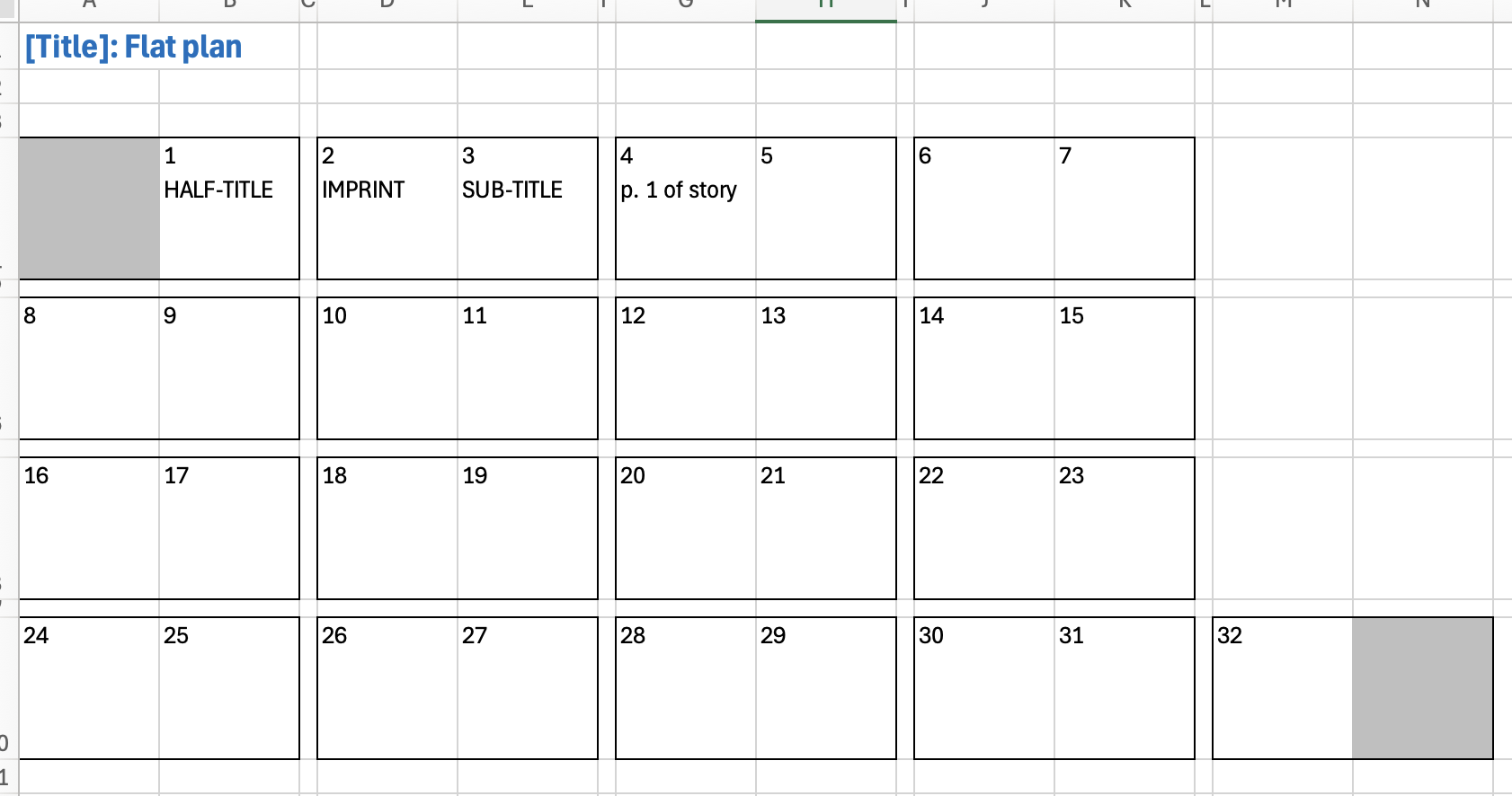
The flat plan template I use
(As an aside, I’ve also used a flat plan when writing kids’ activity books and editing adult non-fiction. They’re not only for picture books.)
Getting feedback
When you’re reasonably sure you’ve taken it as far as you can on your own, it’s time to get other people’s opinions. This is where it starts getting scary.
If you’ve got access to kids in your book’s age range, ask them to read it and get their reaction. Maybe you know parents of kids in the right age range – they’ll have an idea of what their kids like to read. You might have fellow writers who you can ask for feedback. You might also think about paying an experienced editor for a manuscript assessment or structural edit. Here, I mean an editor with actual editing experience, rather than your sister or friend. A good editor will see things you (or your sister or friend) won’t. Then, with the feedback you’ve collected, redraft again.
Getting published
If you haven’t already decided, here’s where you need to decide whether you’re going to try to get a publisher for your story, or whether you’re going to self-publish. There are pros and cons for each, obviously, and your next steps will depend on what you decide to do.
The traditional publishing route
If you’d like to try to go down the path of traditional publishing, the first important thing to do is give the manuscript a close proofread before letting it go anywhere near a publisher. A messy manuscript will put them off straight away.
Then, start researching children’s publishers. The Australian Publishers Association has a list of members, which will give you somewhere to start. Find out which ones accept unsolicited submissions and when they accept them. Read their submission guidelines and follow them carefully and exactly. Sorry for the shouty bold, but I’m dead serious here. Publishers receive so many submissions that it can be overwhelming. I’ve been on the receiving end as an in-house editor and it can feel impossible to keep up with them sometimes. If you don’t follow the guidelines, they might not even look at your submission.
You can also think about approaching literary agents, but bear in mind that it’s just as hard to get an agent as it is a publisher. Also remember that Australia isn’t like the USA – it’s not mandatory to have an agent here, as a lot of publishers will accept submissions directly from authors. (Bear in mind that the major players in Australia – Penguin Random House, Hachette, HarperCollins, Pan Macmillan, Allen and Unwin and Simon and Schuster – are more likely to prioritise agents over submissions directly from authors.) Whichever one you choose, focus on that one for a good nine to twelve months before thinking about trying the other option.
If you’re lucky enough to get a publishing contract, they’ll organise an editor to edit the manuscript, either an in-house editor or a freelancer. Go into the editing process with an open mind. Any suggestions they might have about your story are for the good of the story, and to help your book sell. Having said that, if you’re absolutely against something they’re suggesting, tell them that, and tell them why.
If you’ve written a picture book, remember that the publisher will choose the illustrator; they’ll have a list of illustrators on their books, and will choose one whose style works with your story. If you’ve written a book for early readers or a junior fiction novel, which usually have illustrations sprinkled throughout or on chapter openers, the publisher will organise those illustrations too.
You might not love this idea, but you’ll have to just trust the process on this one.
You’ll get to review illustration drafts and give feedback, and you’ll also see the text and illustrations laid out together and give feedback on the look of the layout as a whole. They’ll want you to go through it all carefully before it goes to print, to look for any errors in the text or illustrations that have been missed up to now (and they’ll have someone proofread it too).
Then it’s off to the printer, and you wait impatiently until your new book is in your hands.
The self-publishing route
A lot of writers decide to go down the self-publishing path, either because they’ve had no luck with traditional publishers or because they want control over the process. It really can be rewarding – you have absolute control, and all the profits go to you. However, the downside is also that you have absolute control – everything is your decision, and it’s your responsibility to act on each decision. It’s a steep learning curve when you first get into it, too: you’ll have to hire an editor, illustrator, page designer and proofreader, organise your ISBN, printing, distribution and marketing, and send legal deposit copies to state and national libraries. It’s a lot. You can try to save money by doing the editing, page designing or proofreading yourself, but it will be obvious in the finished product, unfortunately.
I don’t say all of this to put you off; it’s just the reality. But it can definitely be done, and a lot of authors are doing it well.
There’s so much to write about self-publishing your book that it’s too much to fit in this post. That’ll have to be for another time.
One last thing
Children’s books don’t have to be fiction. I’ve written and edited a lot of books for kids that are informational and educational – CSIRO Publishing is a great example of a publisher that produces amazing information texts, but there are many. There’s also board books for very young kids, as well as activity books (Lake Press does fantastic work in both of these areas, and I’m not just saying this because I used to work there!). So, don’t limit yourself to a fiction children’s book if you think your interests and talents lie somewhere else.
The path from idea to published children’s book author is long and rough, and there are no guarantees at the end of it. But if you’ve got an idea rattling around your head and you keep going back to it, maybe it’s worth a proper look? Start with the idea and see where it takes you.